
“], “filter”: { “nextExceptions”: “img, blockquote, div”, “nextContainsExceptions”: “img, blockquote, a.btn, a.o-button”} }”>
Heading out the door? Learn this text on the brand new Exterior+ app out there now on iOS units for members!
>”,”identify”:”in-content-cta”,”sort”:”hyperlink”}}”>Obtain the app.
Mountaineering isn’t only a pastime—it’s a life-style. Maggie Slepian tackles the climbing life—and the entire joys, issues, arguments, and bizarre quirks that go together with it—in her column.
I spent my childhood in New Hampshire, two hours south of the White Mountains, and that was the place I realized to hike. I climbed a handful of the long-lasting New Hampshire 4,000-footers in highschool, then extra avidly in school. My dad was my fundamental climbing accomplice, and as we checked off extra peaks, the mountains started to occupy a spot in my thoughts even once I wasn’t there. It was my first expertise falling in love with the outside.
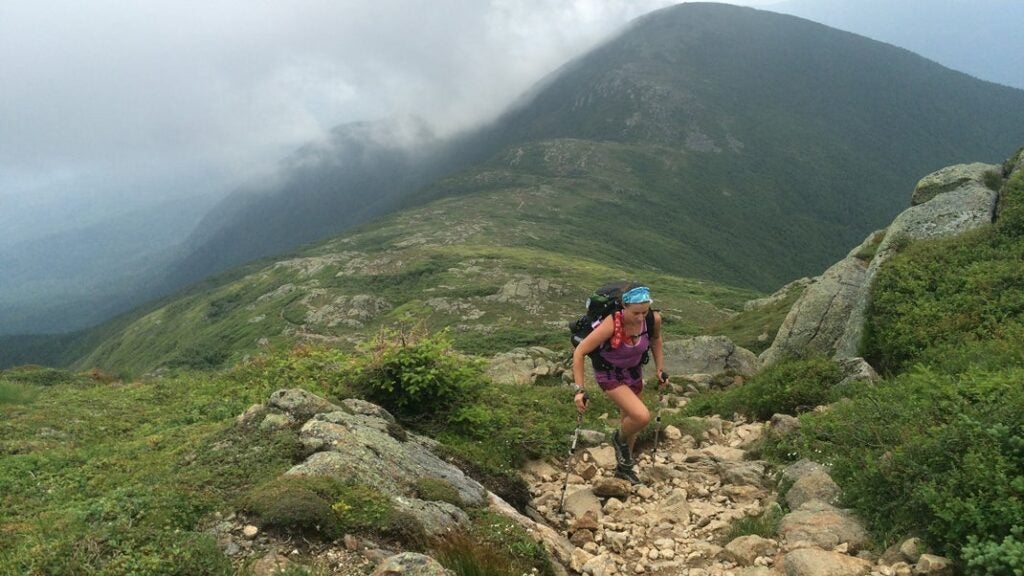
For me, the draw of the White Mountains was within the historical granite, the stunted krumholtz, the pale yellow indicators close to the alpine zone. The paths had been typically little greater than glorified boulder piles, they usually had been brutally difficult. I didn’t know why I cherished it, but it surely made me really feel so full, I didn’t dwell on the query.
I regarded ahead to your entire course of: the pre-dawn get up, our cease on the Ossipee McDonalds for Egg McMuffins, the chilly morning air on the trailhead. Quickly after leaving the car parking zone, we’d be scrambling over rocks and roots, climbing steeply in the direction of the palpable environmental change because the air grew to become clearer and sharper. I cherished the ultimate ascent throughout open rocks earlier than seeing the expanse of the White Mountain Nationwide Forest rippling out under us. 4 thousand toes above sea degree felt like the highest of the world.
RELATED: Alyssa Godesky: A Pupil of Endurance Sports activities
The mountains grew to become a fixation, and I wished extra of them. I used to be captivated by photographs of the west’s immense summits, so every week after graduating, I packed my automobile and drove throughout the nation to seek out them, working for minimal wage in Yellowstone Nationwide Park and spending my free time climbing.
The photographs hyped the place, and the actual factor greater than delivered. The peaks had been so tall and the mountain ranges so expansive, they didn’t make sense to my mind. Snow clung to the couloirs deep into summer season, and the summits stabbed on the sky . I’d stare up at some peak, greater than twice the elevation of the tallest mountain I’d ever climbed, and swear I’d by no means return to my residence state’s stubby hills.
I had been dwelling out west for 2 years when my dad despatched me a message earlier than a visit residence, asking if I wished to hike a couple of extra 4,000-footers throughout my keep in New Hampshire. Positive, I assumed. Why not?
I’d spent the final two years traversing 20-mile ridgelines, cresting high-elevation passes, and bagging 12,000-foot peaks. Whereas the mountains had been greater out west, I’d been shocked to find the paths had been typically simpler. After adapting to the elevation, I discovered I may cruise alongside miles of ergonomic, inviting switchbacks at 9,000 toes with extra ease than navigating the jumbled rockfalls of New Hampshire trails. Within the White Mountains, the paths virtually dared you to hike them. Should you wished to succeed in the summit, you understood there could be no switchbacks and solely uncommon situations of filth tread.
I nonetheless thought fondly of the New Hampshire peaks and the ruggedness of the path, however once I packed my climbing garments, I didn’t contemplate something past the concept that climbing was a great way to spend time with my dad.
Throughout that journey again to New Hampshire, the Whites drew me proper again in from the second we began up the Falling Waters Path in the direction of Mts. Lincoln and Lafayette. The darkish soil and deciduous stands gave option to thinly-spaced pine timber. There have been no switchbacks; some sections of path had been so steep I may attain out and contact the bottom in entrance of my face. It felt as acquainted because the knots in my calves.
RELATED: Energy Mountaineering For Path Runners
I felt tears nicely up as we reached the well-known, sweeping curve of Franconia Ridge. I used to be hundreds of toes decrease than I might be on a summit in Montana, however the familiarity of the path—etched on a mountain chain shaped greater than 100 million years in the past—created a sort of peace and belonging I’d felt nowhere else. I had returned to my residence vary.
“The place are you from?” is a typical query within the transplant-heavy city I stay in. It’s simple to outline {our relationships} to the outside primarily based on the place we began, however once I first moved out west, I wasn’t pleased with being from the northeast’s stubbier peaks. Now, I’m proud to say my love of the outside was born on the White Mountains’ relentlessly difficult trails.
Once we bought residence, I wrote the date subsequent to Lincoln and Lafayette on the 4,000-footer report sheet I’d began in highschool. The date was greater than two years after my final 4,000-footer, however I knew I’d be again.
For the previous seven years, I’ve been engaged on the New Hampshire 4,000-footer listing from almost 3,000 miles away. I’ve simply 11 remaining peaks, and I’m decided to complete them inside the subsequent few years.
I nonetheless stay out west, and I do most of my backpacking and peak-bagging within the Northern Rockies. However there’s a part of me that is still within the tree-covered notches and ruthlessly steep trails of the northeast. After I daydream about climbing, the very first thing I take into consideration is that preliminary splash of daylight once you emerge from tree cowl for the primary time, 4,000 toes above sea degree.
Publication