
If you happen to begin to really feel an ache in your foot as you enhance your mileage or extra acutely, whenever you take your first steps within the morning, it may be time to examine in together with your plantar fascia.
“The plantar fascia is a band of connective tissue on the underside of your foot that runs out of your heels to the bottom of your toes,” Adefemi Betiku, DPT, CSCS, a bodily therapist in New York tells Runner’s World. “It helps your foot throughout weight-bearing actions and helps propel you ahead whilst you’re operating. And if you happen to overdo it or have weak point in different areas of your physique, it might turn out to be infected.”
Whereas not solely runners can get plantar fasciitis—when that band turns into infected—it’s one of many prime 5 most typical accidents runners face, in keeping with a scientific evaluate on musculoskeletal accidents within the sport.
Luckily, there are methods that will help you keep away from plantar fasciitis, in addition to options to easing the ache. Right here’s what that you must know.
Indicators of Plantar Fasciitis
The “-itis” in plantar fasciitis refers back to the irritation, and a few latest analysis suggests “it’s truly a degenerative-tissue damage, and that’s why it’s typically power,” Hamish Vickerman, an Australian physiotherapist who developed the Fasciitis Fighter line of merchandise, explains to Runner’s World.
Typically referred to as fasciopathy or plantar heel ache, it’s excruciatingly painful—with a telltale, capturing ache alongside the only real of your foot from the heel to the arch.
“In delicate instances, the ache might enhance or ‘heat up’ throughout exercise however then turn out to be sore afterward, just like an irritated tendon,” says Vickerman. He notes that the ache is usually additionally worst throughout your first few steps within the morning, as a result of the fascia turns into tight as you sleep.
Frequent Causes & Therapy
A number of issues can contribute to plantar fasciitis foot ache. “An episode of plantar fasciitis could be triggered by a brand new or seasoned runner growing their quantity, velocity, or depth too shortly,” says Vickerman. “We frequently see coaching errors, resembling sudden spikes or will increase in coaching masses. When that occurs, it’s probably the tissue can’t handle the calls for and we see failure at a mobile stage.”
Along with ramping up quantity or depth, it may additionally imply not taking sufficient restoration time between runs.
Unsupportive or worn-out trainers may be the offender—so it would assist to purchase a brand new pair or get orthotics (accepted by your bodily therapist) to slide into your sneakers and provides your arches some further cushion.
One other sneaky trigger could possibly be an ache in a seemingly unrelated physique half, says Betiku, who all the time checks an individual’s again and hips after they go to him with ache of their plantar fascia. Hamstring tightness, in addition to glute weak point can up your threat of the damage.
If doable, taking a pair weeks off from operating to provide your toes some relaxation and restoration is right, says Betiku. However you probably have an upcoming race and actually don’t wish to, taking days off isn’t all the time essential. Nevertheless, it’s best to nonetheless lower your mileage in half for a pair weeks not less than. Evening splints or specialised socks can even assist to alleviate ache for many who really feel it most within the morning. And, after all, if you happen to’re in lots of ache, seek the advice of a bodily therapist.
When you in the reduction of, add the strikes beneath to your periods to assist loosen up the tightness and strengthen all the encompassing, supportive muscle groups directly. You too can carry out these strikes as a preventative measure so that you don’t get plantar fasciitis or to keep away from getting it once more. The secret’s doing them persistently for not less than 4 to 6 weeks, particularly the stretches which require day by day follow to see the advantages.
Along with these strikes, it’s additionally sensible so as to add some myofascial launch to your routine: Roll your foot on a lacrosse or tennis ball, or over a frozen water bottle, which is able to assist to scale back irritation.
7 Workouts for Plantar Fasciitis
1. Calf and Soleus Stretch
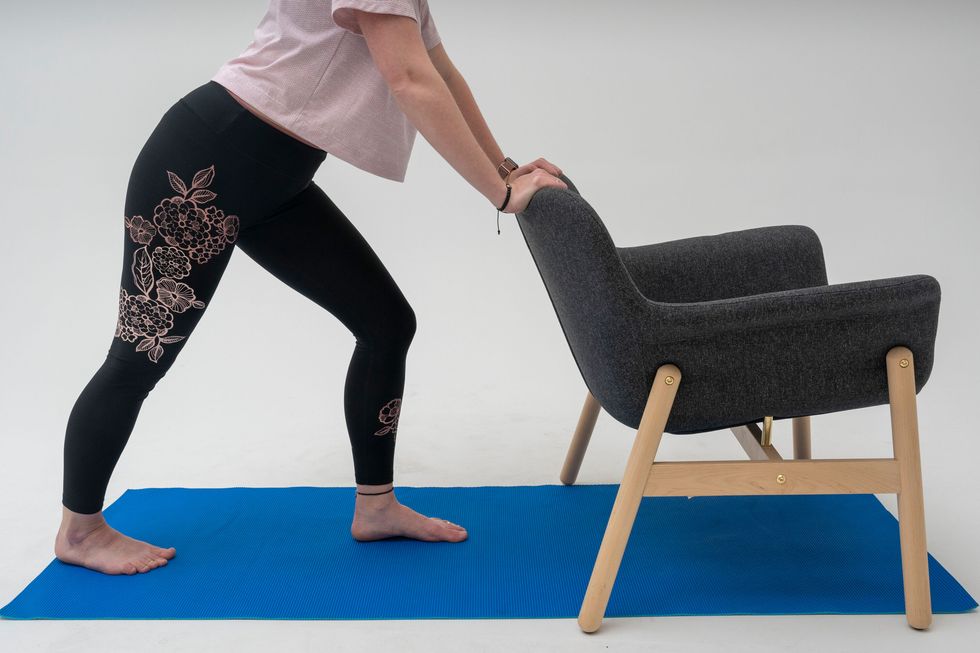
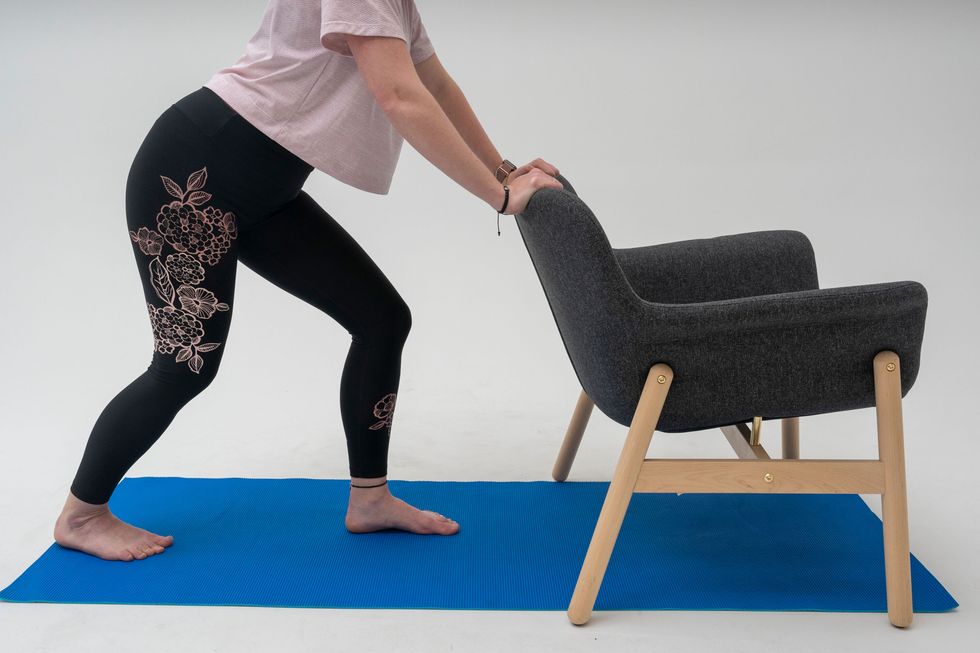
Why it really works: This stretch in your calves might help ease the stress they’re including to your plantar fascia. Make certain to do each variations of the stretch to focus on each sections of your calves: the higher gastrocnemius and the decrease soleus, advises Betiku.
Find out how to do them:
- Stand about arm’s size from a wall or chair with each palms flat towards it.
- Step proper foot again.
- Lean into wall to really feel a deep stretch in calf. Maintain for 15-30 seconds.
- Then bend proper leg till you are feeling the stretch decrease down calf. Maintain for 15-30 seconds.
- Repeat each stretches on reverse aspect. Do 3 units of every.
2. Toe Stretch

Why it really works: This plantar fasciitis stretch could appear counterintuitve, however “stretching the plantar fascia has been demonstrated to be a profitable approach within the remedy of plantar fasciitis, with specific emphasis on mobilizing the massive toe,” says Vickerman.
Find out how to do it:
- Seated, cross proper foot over left knee.
- Grasp toes with proper hand and pull again, focusing probably the most on large toe, till you are feeling a stretch alongside your arch.
- Maintain for 15-30 seconds.
- Then repeat on reverse aspect. Do 3 units.
3. Toe Elevate


Why it really works: “Remoted toe lifts assist strengthen the muscle groups that run alongside the arch of the foot and help the plantar fascia area,” says Vickerman. You’ll probably really feel some aid within the ache as you do that train.
Find out how to do it:
- Stand or sit with naked toes flat on ground.
- Maintaining 4 smaller toes pressed into ground, elevate large toe.
- Pause, then decrease slowly.
- Repeat. Do 10 reps.
- Then, protecting large toe pressed into ground, elevate 4 smaller toes.
- Pause, then decrease slowly.
- Repeat. Do 10 reps.
4. Towel Scrunch

Why it really works: “This transfer works the tiny, intrinsic muscle groups in your foot, which assist help the arch and surrounding space whilst you run,” says Betiku.
Find out how to do it:
- Place a towel flat on the ground and put proper foot flat on an fringe of it.
- Flex toes towards you repeatedly to scrunch the towel again towards foot as a lot as doable.
- Repeat with left foot.
5. Heel Increase


Why it really works: The strengthening energy of this transfer is amped up whenever you do it on a step, with the plantar fascia taut initially of the train. “First do the transfer with each toes in unison, then progress to 1 leg at a time,” says Betiku. You’ll goal the tibialis posterior muscle, particularly, which dynamically helps the arch of your foot.
Find out how to do it:
- Stand with the ball of every foot on the sting of a step, with heels hanging off it so foot is flexed.
- Interact calves and elevate heels.
- Pause, then slowly decrease again down.
- Repeat. Do 10 reps.
6. Clamshell


Why it really works: Plantar fasciitis can steam from weak hips, Betiku says. This transfer is a stable go-to for strengthening the hips.
Find out how to do it:
- Lie on proper aspect, resistance band round thighs, simply above knees. Relaxation head on proper arm. Stack shoulders, hips, and knees, with hips and knees bent about 45 levels.
- Interact glutes and externally rotate left hip, lifting left knee. Maintain toes collectively.
- Pause. Then decrease again down.
- Repeat. Do 10 reps.
- Then swap sides.
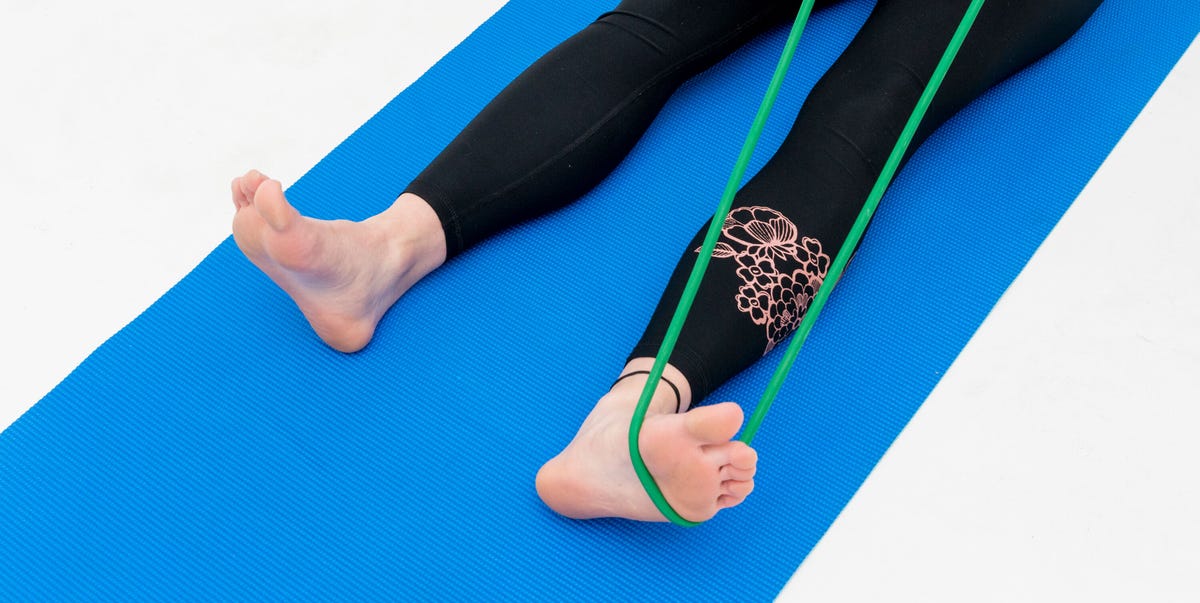
7. 4-Manner Foot Flex


Why it really works: This train strengthens the muscle groups of the foot, but in addition these of the decrease leg that connect to the ankle and assist help your toes as you run, Betiku says.
Find out how to do it:
- Begin seated on ground, legs straight.
- Loop a protracted resistance band round left foot, and maintain in each arms.
- Pull toes towards you.
- Pause. Then return to impartial, toes over ankle.
- Subsequent, level toes towards resistance band (proven left).
- Pause. Then return to impartial.
- Drive foot to the left (proven proper).
- Pause. Then return to middle.
- Drive foot to the correct.
- Pause. Then return to middle. That’s one rep. Do 10 reps.
- Then swap sides.

Laurel Leicht is a author and editor in Brooklyn. She’s coated well being, health, and journey for retailers together with Nicely+Good, Glamour, and O, The Oprah Journal.
John Vasudevan, M.D. is an affiliate professor on the College of Pennsylvania. He’s board-certified in Bodily Medication & Rehabilitation and Sports activities Medication. He’s a Workforce Doctor for UPenn Athletics and medical director of the Broad Avenue Run and Philadelphia Distance Run, and beforehand for the Rock ‘n’ Roll Half-Marathon and Tri-Rock Triathlon in Philadelphia. He’s a director of the operating and endurance Sports activities Medication Program at Penn Medication. Dr. Vasudevan gives non-operative administration of musculoskeletal situations affecting athletes and energetic people of all ranges, and combines damage rehabilitation with damage prevention. He makes use of a wide range of ultrasound-guided procedures and regenerative approaches resembling platelet-rich plasma and percutaneous ultrasonic tenotomy. He sees sufferers on the Penn Medication and the Philadelphia Veterans Administration hospital. Dr. Vasudevan attended medical faculty on the College of Wisconsin College of Medication and Public Well being in Madison. After his Transitional Yr in Tucson, Arizona, he went to residency in PM&R at Thomas Jefferson College in Philadelphia and onwards to Stanford College for his fellowship in Sports activities Medication. He has been in follow on the College of Pennsylvania since 2012.