
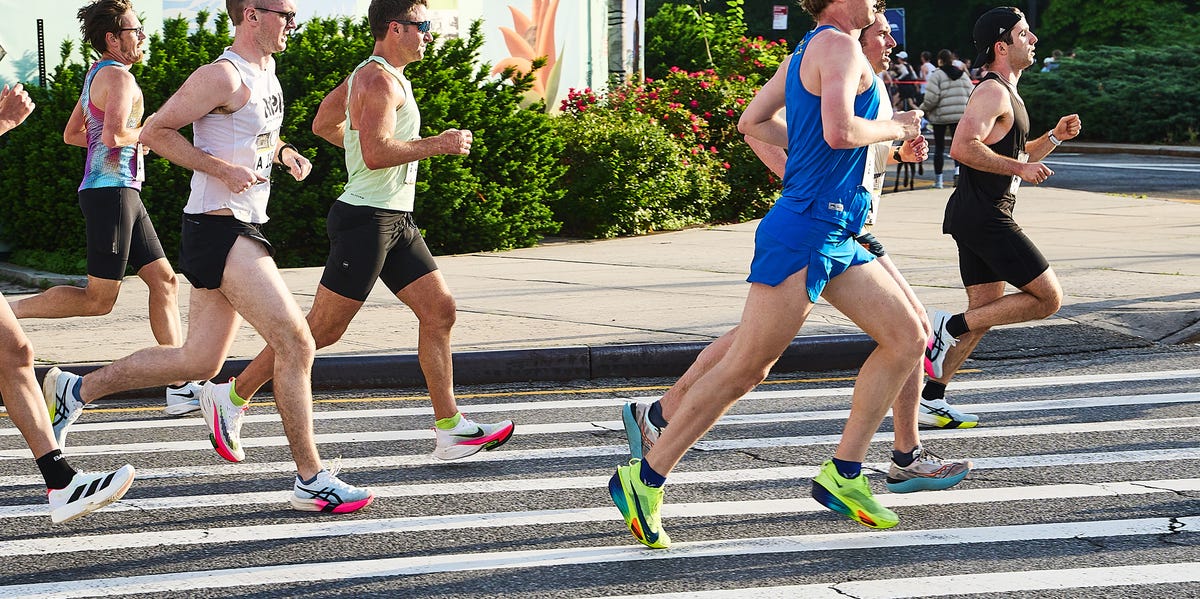
An elite runner’s stride is a stupendous factor. It’s fast, compact, and environment friendly, with a knee effortlessly lifted in entrance of them as the opposite leg extends powerfully behind to propel them ahead with every step.
That gazelle-like type is, partially, the results of a small part of the gait known as the push-off.
“Push-off is the terminal a part of the stance part of working, the place your physique is immediately over the leg and the forefoot is making use of power in opposition to the bottom to propel you ahead,” explains Colleen Brough, DPT, PhD, director of Columbia RunLab at Columbia College in New York Metropolis. “It’s on the initiation of heel rise, the place the heel first begins to return off the bottom, and it ends when the toes go away the bottom and that leg strikes ahead into the swing part. It’s the first mode of ahead movement, acceleration, and to some extent, effectivity in working mechanics.”
Having a superb push-off is most evident with robust, quick athletes. That stated, in the event you’re a runner at any degree, optimizing this a part of your stride must be in your radar. “At quicker paces—whether or not in exercises or races—maximizing a robust push-off turns into particularly crucial for peak efficiency,” says Allison Greer, PT, a former collegiate runner and board-certified scientific specialist in sports activities bodily remedy at Hospital for Particular Surgical procedure in New York Metropolis. “However optimizing efficient working mechanics is essential at any pace.”
It’s possible you’ll consider a push-off as being principally about calves or quads, however quite a lot of parts all through your decrease half mix to make for a robust one. “An efficient and highly effective push-off is determined by the coordination of sufficient energy and mobility all through the kinetic chain,” says Greer. “This begins on the floor and progresses upward, together with huge toe extension mobility, foot and calf energy, hip extension mobility and gluteal and core energy.”
Throughout a great push-off, your again leg must be totally behind your physique, says Brough. When it’s not, the heel begins rising proper after midstance and your foot is beneath you. On this place, she says, you’ve gotten just about zero hip extension. “Your glute max isn’t firing a lot, and your calves aren’t optimized,” she explains. “As an alternative of pushing that stride behind you and driving down into the bottom, you run in entrance of your physique. That’s thought-about overstriding.”
Overstriding from a scarcity of a strong push-off makes you extra inclined to lower-body accidents. (Proof: Runners with hamstring accidents had been extra more likely to overstride and have a rearfoot strike, in comparison with wholesome runners, in accordance with a 2019 examine revealed within the journal Sports activities.) Nevertheless it additionally simply makes your stride much less environment friendly and really feel tougher.
“After we overstride and attain out far in entrance of us as a result of we’ve got restricted push-off, we expertise a braking impulse,” says Brough. “With our heel hitting the bottom in entrance of us, our knee too straight, and our foot dorsiflexed—it’s just like the trifecta of doom for working economic system and for accidents.”
To maximise the facility of your push-off and keep away from inefficiencies on this part of the gait, listed here are eight ideas and tweaks to fine-tune your type and mobility.
🏃🏽♀️Apply Throughout Simple Outings
Speedy runners and a robust push-off go hand in hand. To imitate that type throughout your races, Brough advises engaged on it throughout slower periods. “On simpler runs, you’ll be able to take the time to begin to prepare these mechanics to allow them to be second nature throughout pace work and races,” she says.
Midrun, Brough advises working in your push-off by focusing in your glutes. “Take into consideration squeezing them as your foot hits the bottom,” she says. Additionally, gently lean ahead from the ankles whereas protecting your chest up.
You don’t want to keep up these cues all through the complete run; Brough suggests doing them for 30 seconds to 1 minute in the beginning of your run, once more within the center, whereas going up hills, and in the event you begin to really feel fatigued and see your type slipping.
TRY THESE GLUTE ACTIVATION DRILLS BEFORE EASY RUNS
🏃🏽♀️Visualize a Robust, Flowy Gait
“Think about driving your foot by means of the bottom or pushing the bottom away from you,” suggests Greer. “These are two easy cues to assist maximize push-off energy.”
Brough agrees, advising runners to consider shredding the bottom beneath and behind them. “The imagery will be so highly effective,” she says. “Take into consideration leaving your mud behind you.”
🏃🏽♀️Test If You’re Overstriding
If in case you have entry to a coach or facility that does gait evaluation, that’s an awesome place to start out analyzing your stride. However even in the event you don’t, you’ll be able to look at your individual type by merely having a buddy take a video of you working from the aspect, says Brough. Test to see the place your toes land (beneath you or in entrance), the place they push off the bottom in relation to your physique (proper beneath or behind it) and whether or not your foot is flexed (toes pointing up) or principally flat every time you land.
For those who discover indicators that you simply’re overstriding, you possible aren’t optimizing your push-off, Brough says, and may profit from the stretches and energy strikes under. Growing your cadence also can enable you to keep away from this.
HERE’S HOW TO FILM YOURSELF FOR A GAIT ANALYSIS
🏃🏽♀️Get Extra Versatile
“Tight calves, tight hip flexors, and decreased nice toe extension and vary of movement can all restrict your push-off,” says Brough. “In case your huge toe can’t lengthen, you received’t have the ability to push off almost as a lot.”
Attempt these 4 stretches to enhance mobility within the calves, hips, and massive toe, holding every for 2 minutes complete or 4 units of 30 seconds every:
→Hip Flexor Stretch

- Kneel on proper knee with left knee bent and left foot on the ground in entrance of you.
- Straighten backbone by tucking hips beneath you (keep away from arching low again).
- Have interaction proper glute and shift weight ahead to deepen the stretch.
- Maintain for time, then change sides.
→Gastrocnemius Stretch
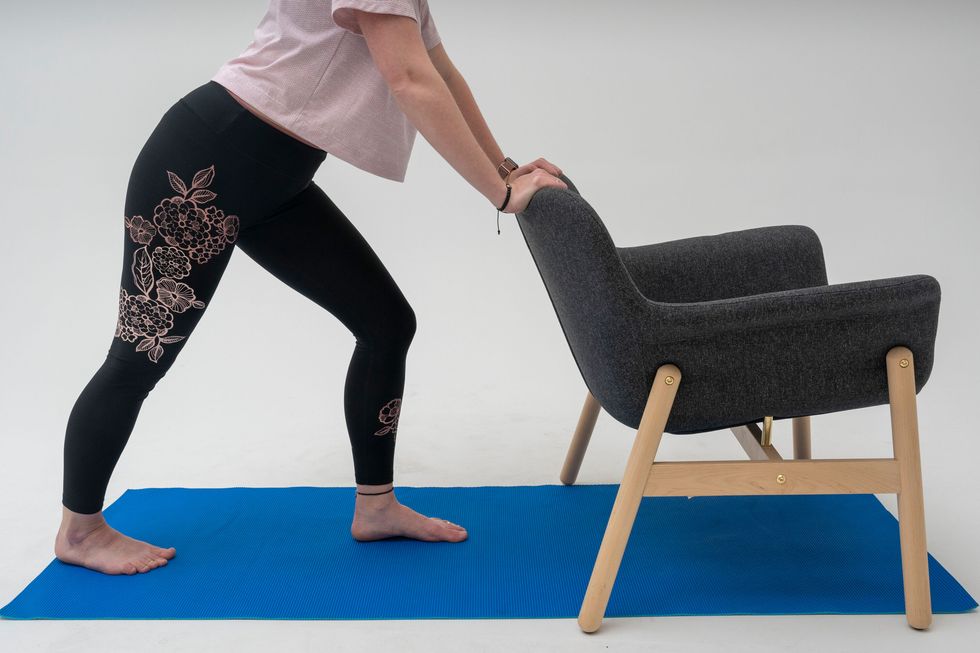
- Stand going through a wall with fingers in opposition to it at chest top.
- Step left foot again and lean ahead, bending proper knee however protecting left knee straight.
- Maintain for time, then change sides.
→Soleus Stretch
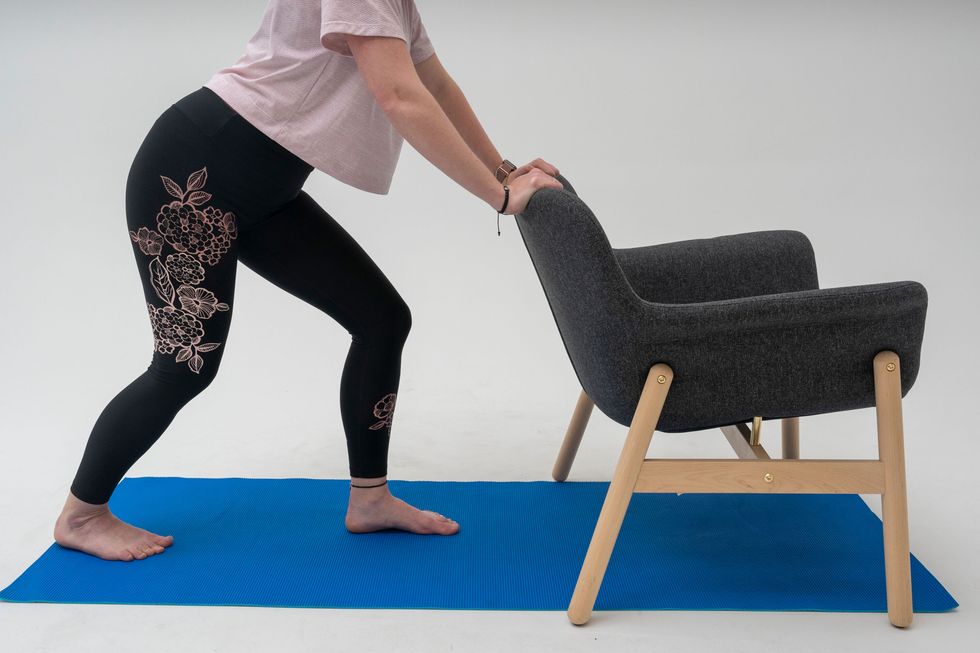
- Stand going through a wall with fingers in opposition to it at chest top.
- Step left foot again and bend each knees. Lean ahead and push in opposition to the wall.
- Maintain for time, then change sides.
→Huge Toe Stretch

- Sit in a chair, with knees bent and toes planted.
- Raise up on huge toes, gently stretching them.
- Maintain. (You are able to do this separately.)
If there’s soreness within the toe for this stretch, cease. “This isn’t a muscle we’re ‘stretching,’ it’s a joint capsule and that is a little more delicate,” Brough says.
🏃🏽♀️Strengthen Your Soles
Though having sufficient mobility is essential, some stiffness can really be a superb factor. “Intrinsic foot muscle groups are essential to push-off since you want a stiff, steady base from which you’ll push off,” explains Brough.
Greer recommends the next transfer to strengthen your toes:
→Arch Dome

- Sit up in a chair with toes flat on the ground.
- Preserving toes straight, tighten muscle groups by means of the only real of toes till arch raises barely. Be sure that to not curl toes below.
- Maintain for 1 second, then calm down.
- Do 30 reps, then change sides.
FIND MORE FOOT EXERCISES HERE
🏃🏽♀️Work Your Core
One train that Greer loves when working in your push-off is a Pallof press. It targets the obliques and glutes. “To optimize push-off energy, runners should lengthen the hip behind them and have interaction the core and gluteal muscle groups,” Greer says. “Plus, the stronger and extra environment friendly the core muscle groups are, the extra steady your base for producing and transferring energy.”
→Pallof Press


- Connect a resistance band to a hard and fast object.
- Stand with it on proper aspect, holding it at chest top in entrance of you with fingers interlocked, elbows bent, toes hip-width aside, and hips simply barely hinged.
- Preserving abs engaged, slowly lengthen arms ahead.
- Maintain 1 second, then bend elbows to convey fingers again towards chest.
- Do 3 units of 10 reps, then change sides.
TRY THIS QUICK FOLLOW-ALONG CORE WORKOUT
🏃🏽♀️Attempt Bounding

Consider this straightforward drill as your common push-off kicked up a notch. “Bounding helps create highly effective hip extension and a robust push-off ranging from the ankle,” says Brough.
- After a warmup, certain ahead by driving entrance knee up, pushing off forcefully by means of the forefoot/toes of again leg, and touchdown softly on midfoot with a fast turnover.
- Take 8 to fifteen bounds (about 20 to 40 meters) ahead for 1 set.
- Stroll again to start out and relaxation 1 minute.
- Do 4 to six units.
THESE FORM DRILLS ALSO SHARPEN YOUR STRIDE
🏃🏽♀️Do Hill Sprints
No, repeatedly grinding it out up an incline won’t be as enjoyable as bounding, however it’s the right technique to hone your push-off type.
“Hill sprints combine your strengthened push-off into your precise working mechanics,” says Brough, who notes that every one the stretches, energy strikes, and mobility drills received’t essentially provide you with a stronger push-off in the event you don’t make it intentional. “For the perfect outcomes and to grow to be your best, you must translate your newfound energy or mobility or motion patterns into your working type itself.”
Discover the Excellent Coaching Plan for You

Get the Plan
Really useful Expertise: No expertise mandatory! Anybody can accomplish this coaching plan.

Get the Plan
Really useful Expertise: This plan is for a brand new runner who’s simply getting again into train.

Get the Plan
Really useful Expertise: For a brand new runner who has been exercising frequently for no less than a 12 months, or somebody who has accomplished a number of 5Ks or 10Ks and may full 6 miles in a single exercise. This plan peaks at 28 miles in every week with a 12-mile future.

Get the Plan
Really useful Expertise: For runners snug exercising for no less than an hour at a reasonable effort. This plan peaks at 32 miles in every week with a 14-mile future.

Get the Plan
Really useful Expertise: For a constant runner used to frequently figuring out 4 to 5 instances every week. The plan begins with a 10-mile future and peaks at 44 to 47 miles every week with a 22-mile future, serving to you common below a 9:10 per mile come race day.

Laurel Leicht is a author and editor in Brooklyn. She’s coated well being, health, and journey for retailers together with Nicely+Good, Glamour, and O, The Oprah Journal.